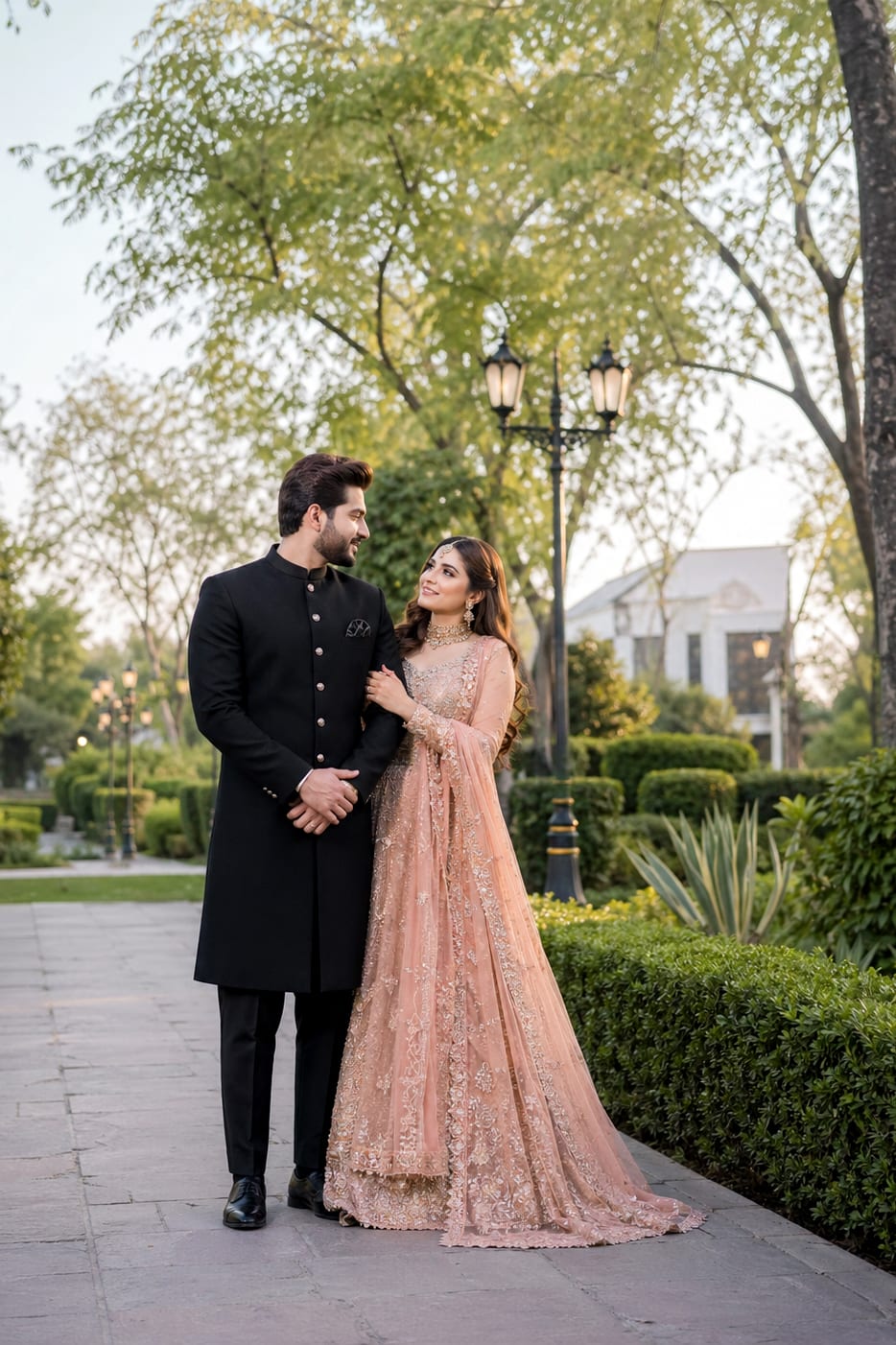
Choose direction that feels compatible
Camera nerves often come from uncertainty rather than from the camera itself. If you do not know whether to look at the lens, where to stand, or how long a portrait will take, every second can feel exposed. A compatible photographer reduces that uncertainty in a way that suits you. Some people relax with active, step-by-step direction. Others want one prompt and plenty of quiet space. Partners may prefer different levels of guidance, and a thoughtful plan can alternate between them instead of forcing one person to adapt all day.
Ask prospective photographers to describe what they actually say during portraits, not only whether their work is candid or editorial. Those labels can mean very different things. Look at complete wedding galleries for transitions, solo portraits, family groups, and difficult lighting, not just a selection of favorite frames. The Knot's suggested interview questions similarly encourage couples to ask about posing, working style, logistics, and full real-wedding galleries. The point is to understand the experience behind the pictures and decide whether that experience will help you settle.
Questions that reveal the working style
- What happens in the first five minutes?
Ask for a plain-language walkthrough of how the photographer starts, gives feedback, and moves on when a prompt is not working.
- How much direction do you give?
Clarify whether guidance is detailed, occasional, demonstrated visually, or adapted to each person rather than relying on a style label.
- Can we decline or change a prompt?
A useful answer should make room for an immediate no, a modified version, or a different idea without requiring an explanation.
- How do you handle a delayed timeline?
Listen for a priority-based plan that protects essential portraits instead of trying to rush through every possible setup.
Make consent and accessibility part of the plan
Portrait direction should never assume permission to touch. Before the event, say whether the photographer may adjust clothing, hair, jewelry, or hands, and whether you would rather make those adjustments yourself or ask a trusted person. The same applies to prompts involving a partner. Holding hands, leaning together, embracing, or placing a hand at a waist are options, not requirements. A photographer can describe or demonstrate an adjustment and wait for agreement rather than physically moving anyone into place.
Accessibility is not a separate favor added after the portrait plan is made. It shapes location, timing, communication, and the kinds of prompts that will be useful. Discuss stable routes, surface changes, stairs, seating, shade, nearby quiet space, and realistic distances. Share the support that helps, without feeling obliged to disclose a diagnosis. Mobility aids should be treated as part of a person's space and never moved without permission. Pain, fatigue, balance, hearing, vision, and sensory access can also fluctuate, so build in choices rather than a single supposedly correct setup.
The ADA National Network's temporary-event planning guide emphasizes planning early, maintaining accessible routes, removing obstacles, and asking the person what communication or assistance is effective. Those principles transfer well to portrait planning even outside the guide's legal context. Clear spoken cues, a visual demonstration, extra processing time, a chair, a seated version of a prompt, or fewer location changes can improve the session for many people. Confirm preferences directly instead of asking a companion to speak for someone who can answer for themselves.
Details worth agreeing in advance
- Touch
Name who, if anyone, may adjust garments or accessories, and agree that consent can be withdrawn at any point.
- Communication
Choose concise verbal cues, demonstrations, written notes, an interpreter, or another method that works for the people being photographed.
- Movement and rest
Set comfortable walking and standing limits, identify seats, and allow breaks without treating them as lost time.
- Location alternatives
Pair every stairway, lawn, or distant portrait spot with a close, stable, accessible option that still has purposeful light and composition.
Use movement to replace performance
A movement-based prompt gives the body a task and lets the photographer work with the transitions. It can be as small as taking one breath, turning toward a voice, smoothing a cuff, or shifting attention from the garden to your partner. It does not have to mean walking quickly, spinning, or repeating an action until it looks spontaneous. The best prompt fits the available space, clothing, energy, and mobility, then ends before it becomes a routine.
Connection also reads through attention, not only through physical closeness. Two people might look at each other, listen while one quietly recalls a shared detail, stand shoulder to shoulder, or notice what is happening beyond the frame. If touch is welcome, it can be simple and familiar rather than arranged into an unfamiliar shape. If it is not, matched eye lines, shared direction, and responsive expressions can create an equally connected portrait. There is no need to assign one partner a protective role and the other a delicate one.
Low-pressure prompts with a clear purpose
- Walk to a real destination
Move a short, safe distance toward a doorway, seat, or family member instead of pacing back and forth for the camera.
- Reset and return
Look away, release the shoulders, breathe, and bring attention back to the same person or point when ready.
- Share a private cue
Use a familiar phrase, memory, or observation that creates genuine attention without demanding laughter or a particular emotion.
- Adapt the scale
Replace a long walk with a hand movement, head turn, seated shift, or change of eye line when that is safer or more comfortable.
Give posture, hands, and eye line one job
Helpful posture direction is about stability, breath, and intention, not making someone look thinner, taller, tougher, or softer. Start with a base that feels secure. That might mean feet comfortably apart, weight supported by both feet, one foot placed where a long garment will not catch, or a seated position with the chair exactly where it is needed. Let the jaw and shoulders release on an exhale. If a cue causes strain, trembling, dizziness, or pain, it is the wrong cue for that moment.
Hands look uncertain when they are given no information, so give each hand a light task. It can hold flowers without squeezing, rest on a comfortable part of your own clothing, touch a partner with permission, or remain relaxed at your side. Avoid constantly changing every finger. Eye line can be just as simple: toward the lens for a direct portrait, toward a partner for connection, or toward a specific object for a quieter frame. A named target works better than the vague instruction to look natural.
Solo portraits deserve the same care as couple portraits. They record each person's clothing, expression, and presence without reducing anyone to a supporting role. Decide whether you want direct, reflective, joyful, fashion-led, or minimally guided solo frames, and allow different answers for different people. Direction should respond to personality and comfort, not assume that masculinity requires stiffness or femininity requires a particular hand, head tilt, or expression.
A four-part physical reset
- Base
Choose a stable standing or seated position and check the ground, garment hem, mobility aid, and nearby obstacles first.
- Breath
Exhale normally and release effort that is not helping, without forcing the chest, stomach, shoulders, or chin into a shape.
- Hands
Assign one familiar, comfortable action and change it only when there is a compositional reason.
- Eyes
Pick one clear target, then let blinking and expression happen rather than trying to hold an unbroken camera-ready stare.
Treat clothing and accessories as practical objects
Formalwear changes how a person can sit, turn, walk, and regulate temperature. Test those actions before the wedding while wearing the actual layers or something with similar weight. A heavy lehenga may need a shorter walking route, a clear place to set the hem, and time to settle before the frame. A dupatta may be pinned, draped, carried, or allowed to move, but its wearer should decide who may arrange it. Repeated turns or sweeping motions are not necessary if they pull, snag, or create fatigue.
A sherwani can feel different when fully fastened than it did during a brief fitting. Check the collar, cuffs, arm range, closure tension, footwear, and comfort while seated. Plan a private moment to cool down or adjust layers if the event or weather calls for it. These are garment questions, not gender rules. Anyone wearing structured, layered, fitted, or heavy clothing benefits from testing movement and telling the photographer which actions are comfortable.
Jewelry and footwear can quietly determine whether a portrait feels relaxed. Wear-test earrings, necklaces, headpieces, bangles, watches, and pins long enough to find pressure or snag points. Check whether an accessory catches a dupatta, hair, veil, collar, or another person's clothing during a close prompt. For shoes, consider the actual surfaces between the preparation room, garden, stage, and ceremony. A planned change of footwear or a stable portrait location is more useful than enduring pain while trying to appear at ease.
A practical attire check
- Move through the real actions
Sit, stand, take a few steps, use stairs if relevant, raise each arm comfortably, and turn without asking the garment to do more than it can.
- Choose an attire helper
If wanted, name one trusted person who knows the intended drape, fastenings, and boundaries so several people do not pull at the outfit.
- Map the ground
Identify grass, gravel, wet paths, cables, steps, and stage edges, then choose shoes, support, or alternate routes accordingly.
- Pack for comfort
Keep approved fasteners, a cloth for footwear, water, and any personal comfort items close to the portrait location rather than across the venue.
Organize family groups without turning them into a queue
Family photographs become stressful when nobody knows which combinations matter or who is ready. Write a short priority list using names, not only labels such as aunt or cousin, because families do not all use the same structures. Tell the photographer privately about separations, bereavements, strained relationships, or anyone who should not be placed together. Choose a coordinator from each relevant group who recognizes people and can gather them while the photographer finishes the current frame.
Sequence groups around real needs. Someone who tires easily, a child near the end of their patience, or a guest who must leave may need an early photograph, but ask rather than assuming based on age or appearance. Keep chairs and mobility aids in the arrangement when they are wanted, and compose the group around them instead of placing the person at the edge. Use a location with a clear route and enough room, then change as few people as possible between frames.
When the timeline contracts, protect the combinations that cannot be recreated rather than rushing everyone through a long generic checklist. Agree on a small must-have tier and a second tier for extra time. One careful portrait with each essential group is more valuable than many near-duplicates made while names are being shouted and guests are missing the ceremony or meal. The photographer, planner, and coordinators should know who can decide to stop the list and move the day forward.
What a usable group list contains
- Named combinations
Write every person in each group and order the groups so only one or two people move between consecutive frames.
- Priority level
Mark the combinations that must happen and the ones that can be released if travel, weather, or ceremony timing changes.
- Access and timing notes
Record requested seating, communication support, a clear route, an early departure, or a needed break without adding private medical details.
- One decision maker
Name the person authorized to shorten the list so the couple is not asked to solve logistics while being photographed.
Practice briefly and protect time on the day
A small pre-event practice can remove the novelty without teaching you to perform. Set aside ten quiet minutes with your partner or a trusted person. Use a phone at normal viewing height, without filters, and try one direct portrait, one shared eye line, one short movement, and one comfortable solo frame each. Notice which instructions are clear, which touch feels natural, whether clothing limits an action, and whether you prefer more or less feedback. Then stop. The aim is vocabulary, not a perfected face.
On the wedding day, portrait time should have a beginning, a priority, and an exit. Build a modest buffer after dressing and before any hard deadline, especially if travel, outfit changes, or family gathering is involved. Keep water, seating, and attire help nearby. If time is lost, simplify locations and protect the essential people rather than increasing the pace of every movement. A calm two-minute reset often produces more useful frames than ten minutes of hurried corrections.
Tell the photographer what worked in practice. A note such as 'give us one action at a time,' 'please warn us before a close crop,' or 'we settle after a quiet minute' is actionable. You can also choose a simple pause signal if either person needs the camera lowered. Preparation succeeds when it makes the session easier to inhabit, not when it removes every blink, crease, pause, or imperfectly timed laugh that proves the day was real.
A ten-minute practice
- Minutes one to two
Stand or sit together, choose a stable base, breathe, and decide what amount of spoken direction feels useful.
- Minutes three to five
Try one short movement and one no-touch connection prompt, then keep only the versions that feel comfortable.
- Minutes six to eight
Make one solo portrait each with a clear hand task and eye line, without prescribing different poses by gender.
- Minutes nine to ten
Write down one useful cue, one boundary, one attire concern, and one access or rest requirement to share with the photographer.
Final thought
Natural photographs come from workable conditions
A natural wedding portrait is not one in which every person forgets the camera exists. It is one in which the direction is clear enough, the environment is comfortable enough, and the boundaries are respected enough for attention to move somewhere more meaningful. That might be a partner's expression, a family member arriving, the weight and detail of formal clothing, or simply the relief of being given one manageable task.
Choose a direction style that fits, discuss consent and access before the timeline is fixed, and reduce physical decisions to a stable base, an easy hand task, and a clear eye line. Plan garments and family groups with the same care as locations. A brief practice can make those choices familiar, but the goal is still presence rather than polish. The photographs should recognize how you actually connect and move, not ask you to become a different person for the frame.
Sources and further reading
These references informed the planning context. The article itself was written specifically for the ExposurePro Journal.