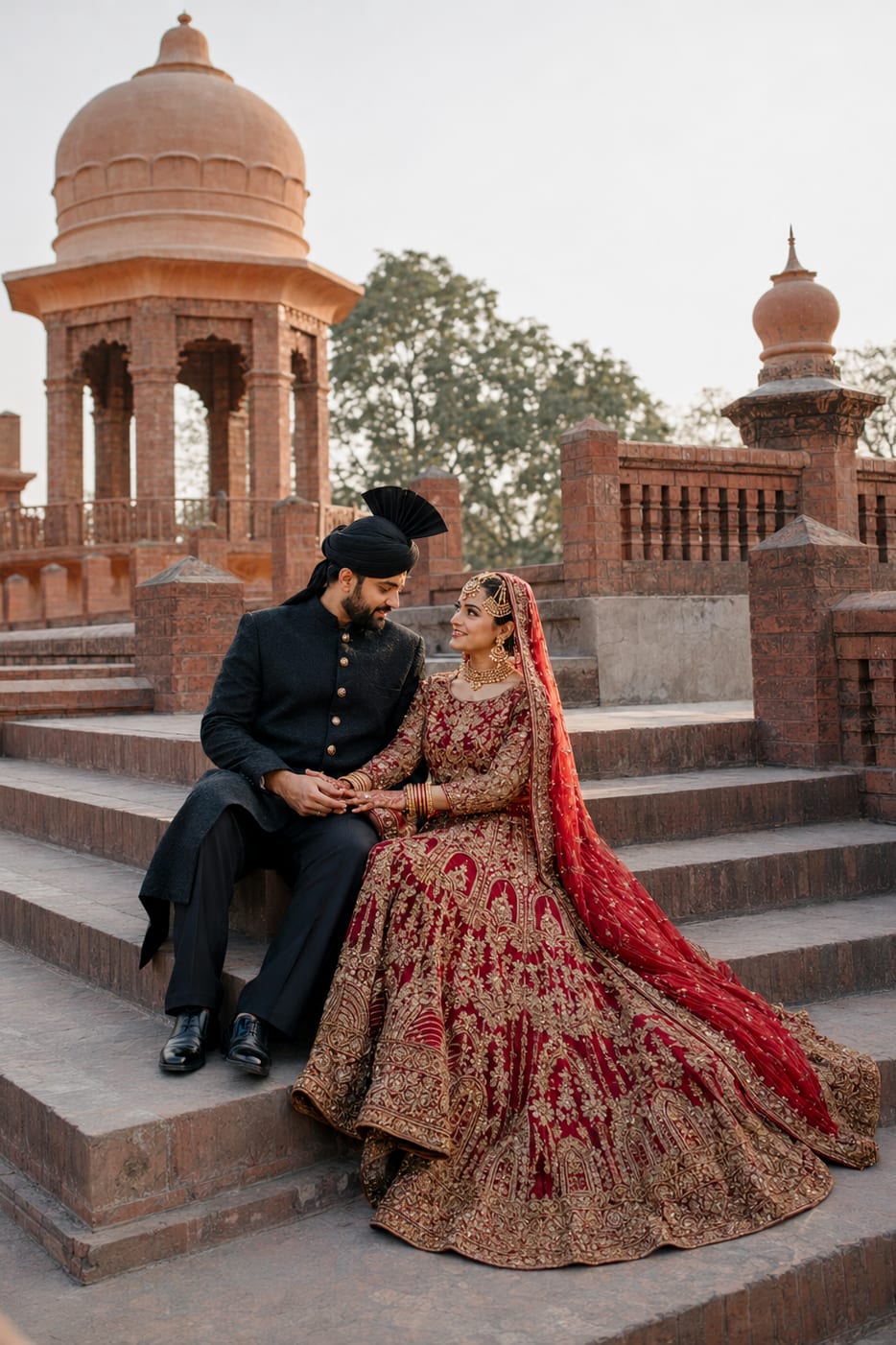
Start with the family's vocabulary, not a standard order
Begin with a blank calendar and let the couple or their chosen family contact name every gathering. Ask what each name means in their household, who hosts it, who attends, and what changes when guests move from one event to the next. A mehndi may be a large shared celebration, a smaller gathering centered on henna, or one part of another evening. A nikah may take place at home, in a mosque, at a venue, or alongside a reception. A baraat may refer to an arrival, a larger function, or both. A walima may follow soon after or at a later date. None of those possibilities should be assumed from the label alone.
This caution is supported by the wider record. Research on Pakistani wedding invitations describes how religious and socio-cultural influences shape the way celebrations are presented, while guidance on Muslim weddings emphasizes substantial regional and family variation. Even the Punjab Marriage Functions Act 2016 defines marriage broadly enough to include ceremonies before and after the formal wedding, listing examples such as mayun, mehndi, barat, nikah, rukhsati, and walima. These sources offer context, not a script for an individual family. The family's current plan remains the working authority for photography.
Questions that reveal the real structure
- What is this event called here?
Record the family's preferred name and spelling, then add a plain-language note about what will happen.
- What is fixed and what is flexible?
Separate ceremony times, venue deadlines, prayer considerations, travel, entrances, and meal service from movable portrait windows.
- Who is expected?
Note whether attendance changes by event, including elders or relatives who will appear on only one day.
- What should not be inferred?
Ask about room access, seating, gender arrangements, and customs directly instead of guessing from an event name.
Build an event map that people can actually use
An event map is more useful than a single long timeline. Give each gathering its own row or page with the date, address, coverage window, estimated attendance, rooms in use, travel time, parking or loading details, venue contact, and a short sequence of meaningful moments. Add the earliest time the photography team can enter, where equipment may be placed, whether shoes must be removed in a prayer space, and any limits on flash or movement. If portraits depend on daylight, write down sunset and the latest realistic start rather than describing the session only as 'after arrivals.'
Contacts should be specific to the way the celebration is organized. One person may know the ceremony, another may control access to a private preparation room, and another may be best at locating relatives. This does not always divide neatly between two family sides. Choose a primary decision contact and a privacy or family-group contact for each event, with a backup if either person is occupied. The couple should not have to answer routine logistics while getting ready or taking part in a ceremony.
Local constraints belong on the map too. The cited Punjab law includes requirements for marriage functions in public places, including a 10:00 pm conclusion in its published text. It should not be treated as universal legal advice, and rules or enforcement may change. For an event in Punjab, the planner and venue should confirm current obligations. For an event elsewhere, the relevant venue and jurisdiction may have entirely different requirements. Photography coverage should fit the verified plan rather than encourage a function to overrun it.
Minimum information for every event
- Sequence
List arrivals, ceremony actions, performances, greetings, portraits, food, speeches, and departures in the family's expected order for that event.
- People
Name the couple, elders, witnesses, speakers, performers, family coordinators, and anyone attending only that gathering.
- Spaces
Mark public, private, prayer, preparation, women-only if applicable, and no-camera areas, including who can grant access.
- Decision points
State who can shorten portraits, approve a room change, or choose between competing priorities when the schedule moves.
Create visual continuity without flattening each event
Continuity comes from repeated visual grammar, not identical pictures. The same approach to skin tone, contrast, framing, and moment selection can connect a bright daytime nikah with a saturated evening mehndi and a formal walima. Establishing frames at each location, clean portraits of the central people, close relationship moments, and a final transition image give an editor comparable building blocks. A recurring architectural line, doorway, hand gesture, textile, or family relationship can act as a quiet motif across days.
At the same time, forcing one preset, one posing routine, or one lighting style onto every event can erase what made the gatherings distinct. Colored dance lighting may belong to the energy of one evening, while soft window light may express the stillness before a ceremony. The aim is a coherent voice with room for tonal shifts. Agree in advance on what the family wants the finished story to feel like, then let the actual light, pace, and relationships shape each chapter.
Useful continuity anchors
- One opening frame per event
Show the place, scale, weather, or room before moving into close details and faces.
- Recurring relationships
Notice how a parent, sibling, grandparent, or close friend supports the couple differently across the celebrations.
- Consistent portrait intent
Make space for an individual portrait of each partner and a portrait together when access, custom, and timing allow.
- Transitions
Photograph arrivals, room changes, outfit finishing, quiet pauses, and departures so the final story can move between major scenes naturally.
Track wardrobe and detail transitions with purpose
Multi-event clothing and details often carry the clearest visual signs of progression. Build a short detail note for every gathering instead of one generic flat-lay list. Record each outfit, footwear, jewelry, watch, cufflinks, dupatta, turban or sehra if used, floral jewelry, rings, invitation pieces, gifts, and family heirlooms that the couple wants documented. Henna may deepen or soften over time, flowers may change, and an heirloom may appear for only one ceremony. Those transitions can locate a photograph in the wider story without a caption.
Details should not take priority over the people who give them meaning. Ask who owns or presented an object, whether it may be moved, and when it will be available. Photograph a keepsake in context, such as an elder fastening it or a sibling carrying it into the room, as well as in isolation when time permits. Sacred text and formal documents are not styling props. They should never be rearranged for symmetry without explicit permission and respectful handling by an appropriate person.
A practical detail handoff
- Label by event
Place approved items in a tray or clear area with a note naming the event and the person who can answer questions.
- Flag irreplaceable pieces
Identify heirlooms, borrowed jewelry, religious items, and documents so the team does not move or leave them unattended.
- Set a return time
Agree when every item must be back for dressing, the ceremony, or family presentation.
- Prioritize lived detail
If time contracts, photograph the item being worn, held, signed, or exchanged rather than delaying a person for a complex arrangement.
Ask direct questions about crew continuity
The same lead photographer across all events can retain names, relationships, access notes, and visual intentions, but that arrangement is not always available or necessary. What matters is knowing the plan. Ask whether the named lead will attend every gathering, which events use associates or second photographers, and whether staffing changes for small or private functions. If a women-only area is planned, discuss whether an approved photographer is needed there and exactly when cameras may operate. Do not assume that such an area exists, or that one staff member's access automatically extends to the full crew.
When people change, information has to travel. A shared brief should include pronunciations, key relationships, family group priorities, ceremony cues, access rules, sensitive circumstances, and visual references from earlier events. The incoming photographer should know what has already been covered without trying to recreate it mechanically. The team also needs a defined response if illness, transport disruption, or a venue change affects staffing. The answer should be clear in the agreement, not invented during the celebration.
Crew continuity questions to put in writing
- Who is assigned where?
Request names or roles for the lead, additional photographers, assistants, and any person covering a restricted space.
- How are notes transferred?
Confirm that updated schedules, family maps, pronunciations, privacy limits, and prior coverage notes reach every assigned person.
- How is the visual approach aligned?
Ask who directs exposure, lighting, file settings, and editing decisions across cameras and dates.
- What happens if the plan changes?
Clarify replacement staffing, travel responsibilities, decision contacts, and the process for approving a materially different arrangement.
Photograph the nikah and rukhsati with restraint
A nikah deserves a cue-by-cue conversation with the couple, officiant, or informed coordinator. Guidance on Muslim wedding traditions identifies the marriage contract as central to the nikah, but the setting, participants, sequence, and practice differ. Ask where each person will sit, whether the proceedings occur together or in separate spaces, who the witnesses are, which moments can be photographed, and whether flash or movement is acceptable. If a nikahnama is visible, seek permission before making a close image and again before any image that reveals personal information is shared. Never pause a signing, reach across participants, or reposition the document for the camera.
Rukhsati can hold joy, composure, sadness, relief, or several feelings at once. The photographer's responsibility is to observe, not produce a required emotional performance. Do not ask someone to cry again, repeat a farewell, or hold an embrace for a more dramatic frame. Confirm whether the family welcomes close coverage, prefers distance, or wants cameras lowered at a particular threshold, prayer, embrace, or departure. Leave clear paths for elders and the couple, and do not turn a vehicle exit into a lighting setup that delays people.
Consent is specific rather than blanket. Permission to photograph the main hall does not necessarily cover a preparation room, a women-only area, a private prayer, a child, or online publication. Record restrictions in the crew brief and offer a discreet way for preferences to change during the event. When uncertain, lower the camera and ask the designated contact. A missed photograph is usually easier to accept than a breach of trust.
Sensitive moments to clarify in advance
- Ceremony access
Confirm room boundaries, footwear, movement, flash, sound, and whether photographers may cross between spaces.
- Document visibility
Separate permission to capture the nikahnama from permission to deliver, publish, or post an identifiable close-up.
- Farewell distance
Choose whether rukhsati is covered close, from the room edge, outside only, or not at a particular point.
- Changing consent
Give the couple and named contacts a simple signal or direct route to pause coverage without explanation.
Protect the files, then edit one coherent story
Several event days create several handoff points, so ask for a concrete file workflow. Useful questions include whether cameras can record to two cards, when cards are ingested, how copied files are verified, how many working copies exist, whether one copy is kept separately, and when cards are cleared for reuse. After each gathering, the team should know who holds the originals and who confirms the next day's media is ready. Exact methods vary with equipment and travel, and no responsible process makes loss impossible. The goal is layered risk reduction, not an absolute promise that nothing can ever fail.
The final edit should reward the planning. Rather than treating each date as an isolated gallery, look for an opening, development, and resolution across the full set. Establish the people and places, let clothing and details mark transitions, return to important relationships, and preserve quiet intervals between crowded scenes. Repetition should deepen meaning, not fill space. Three photographs of the same elder across different days may say more than thirty near-identical stage greetings.
Before delivery, review privacy decisions across the complete collection. A picture that felt harmless alone may reveal a private room, document, address, or family circumstance when placed beside another image. Confirm any separate publication permissions and keep the private family record distinct from a website or social media selection. Coherence includes ethical consistency: the same care shown during capture should continue through editing, sequencing, and sharing.
What to request from the final narrative
- Distinct chapters
Preserve each event's atmosphere while using color, pacing, and recurring people to connect the set.
- Balanced relationships
Check the story against the family map so visibility follows stated priorities rather than whichever group gathered most easily.
- Meaningful transitions
Include enough preparation, travel, room, and departure images to explain how one celebration became the next.
- A separate sharing edit
Approve public-facing images independently from the private gallery, especially where children, private spaces, or documents appear.
Final thought
Plan the connections, leave room for the real celebration
The strongest multi-event wedding story is neither a rigid checklist nor a collection of unrelated highlights. It is a record of changing rooms, clothes, responsibilities, and emotions held together by recognizable people and a consistent point of view. That record starts with the family's language and priorities, then becomes practical through an event map, named contacts, an informed crew, and clear consent boundaries.
Once those foundations are in place, photography can stay responsive. A delayed entrance, a quiet exchange with an elder, or an unexpected gathering of relatives does not have to threaten the plan. It can become part of the story because the essential ceremony, privacy, file care, and relationship priorities are already understood. The result can feel coherent without suggesting that every family celebrates in the same way.
Sources and further reading
These references informed the planning context. The article itself was written specifically for the ExposurePro Journal.