Replace the giant checklist with a priority system
Long online checklists can be useful prompts, but they often give a centerpiece and a grandparent the same visual weight. They can also tempt everyone to measure success by quantity rather than meaning. General wedding photography guidance from The Knot recommends narrowing a wish list to the pictures a couple definitely wants and communicating special people or heirlooms in advance. For a family-first plan, that narrowing is the central task, not the last edit before sending the list.
Sort requests into three levels. First are people and actions that cannot be recreated, such as an elder attending one event, the nikah witnesses, a document signing if photography is permitted, or a farewell with a relative leaving early. Second are high-value portraits and relationships that have more than one possible window. Third are optional variations, decorative details, and extra combinations. This ranking does not make the lower levels unimportant. It gives the photographer an honest decision rule when a ceremony starts early, travel runs late, or a room becomes unavailable.
The one-page priority card
- Five essential people or relationships
Use names, not labels alone, and state at which event each person will be present.
- Three unrepeatable actions
Examples might include a signing, an elder's blessing or greeting, a planned entrance, or a departure, depending on the family's events.
- Three meaningful objects
Name the heirloom, jewelry, invitation, gift, or clothing detail and the person connected to it.
- Three restrictions
State no-camera spaces, publication limits, family sensitivities, and any person who should not be grouped together.
Draw a family map and verify every relationship
Kinship words can make a family map more precise when the family actually uses them. Khala usually refers to a maternal aunt, phuppo to a paternal aunt, mamu to a maternal uncle, and chachu is commonly an affectionate term for a paternal uncle, often a father's younger brother. Usage, spelling, age distinctions, and forms of address can vary by language, household, and diaspora community. Ask each person how they should be named and pronounced. A photographer should never point to a stranger and guess, 'You must be the phuppo.'
A family map is a logistics tool, not a ranking of affection. Include parents, stepparents, guardians, grandparents, siblings, siblings' partners, close aunts and uncles, cousins, chosen family, and any other relationships the couple identifies. Note where separation, bereavement, illness, or conflict affects grouping, but share sensitive notes only with crew members who need them. If the family wants to acknowledge someone who has died, follow their requested form, such as photographing an heirloom or reserved place. Do not manufacture sadness or ask anyone to perform grief for a picture.
Fields for a useful family map
- Name and pronunciation
Add the preferred form of address and a phonetic cue where it will help the photography team speak respectfully.
- Relationship in the family's words
Record terms such as khala, phuppo, mamu, or chachu only after confirming that the person uses them.
- Attendance
Mark the exact event or time window, especially for relatives who are arriving late or attending only one function.
- Practical needs
Note mobility, hearing, seating, transport, health, feeding, or time constraints without adding unnecessary personal detail.
- Grouping notes
Flag requested combinations, blended-family preferences, and groups to avoid, using neutral and discreet language.
Place elders, witnesses, and ceremony essentials first
Elders should not spend a long portrait session standing under hot lights or waiting while distant combinations are assembled. Ask where they will be seated, whether they use a cane or wheelchair, whether stairs are involved, and when their energy is likely to be best. A chair can be part of a dignified group portrait rather than treated as an inconvenience. Photograph greetings and conversation as well as formal groups, particularly when an elder is more comfortable remaining in place.
For a nikah, identify the officiant, witnesses, couple, and any relatives with a defined role before coverage begins. General Muslim wedding guidance describes the marriage contract as central to the nikah, but actual arrangements vary by family, school of thought, venue, and jurisdiction. Learn the cue sequence from someone who understands this ceremony. Do not infer that every participant will be together in one room or that every signing is open to photography.
The nikahnama deserves its own permission. Ask whether the act of signing may be photographed, whether a close view of the document is wanted, and who may handle or turn it. Names, addresses, identity numbers, signatures, financial terms, and other personal information may be visible. Permission to capture a private archival image is not permission to publish it. If consent is unclear, frame hands and relationships without making the text legible, or leave the document unphotographed.
Ceremony priority checks
- Elders present
List where they will be, their shortest comfortable portrait window, and the coordinator who can bring the couple to them.
- Witnesses identified
Provide names, roles, room locations, and any time at which a witness must leave.
- Cues understood
Confirm entrances, recitation or remarks, acceptance and signing moments as applicable, while respecting directions from the officiant.
- Document consent recorded
Write separate choices for capture, readable detail, gallery delivery, and any public use of a nikahnama image.
Photograph preparation details in their relationships
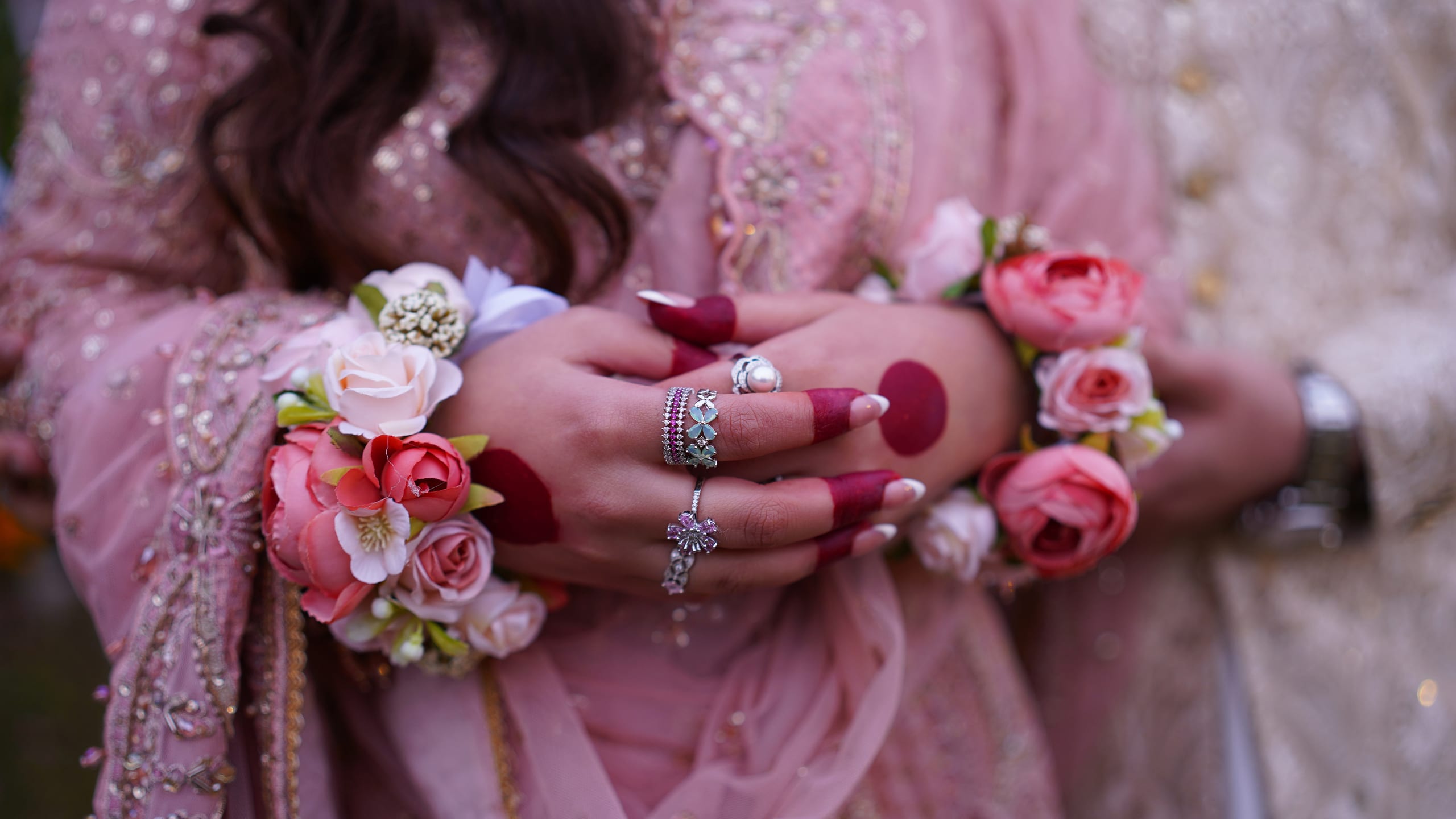
Preparation gives context before a crowded function begins. Start with the items that locate this particular celebration: henna, floral jewelry, rings, outfits, shoes, a dupatta, turban or sehra if used, perfume, cufflinks, an invitation, and heirlooms selected by the family. The most meaningful frame may not be an isolated arrangement. It may be a khala checking a fastening, a mamu carrying a carefully packed gift, friends helping with jewelry, or a parent pausing at the doorway after the outfit is complete.
Ask before moving anything valuable, sacred, borrowed, or easily damaged. A Quran or other sacred text should not be treated as a decorative layer beneath jewelry, and formal documents should not be added to a flat lay merely because they match the color palette. Set a short detail window and a return deadline so photography does not hold up dressing. When two people prepare in different locations, rank which relationships need simultaneous coverage and whether staffing can support it rather than promising every small object in both rooms.
Preparation images worth prioritizing
- Hands and finishing gestures
Photograph hennaed hands, rings, floral jewelry, cuff fastening, pinning, tying, or another real act of getting ready.
- One complete clothing portrait
Make a clear full-length image once each partner is ready, with enough time to adjust posture and fabric without delaying departure.
- The person behind an heirloom
Pair the object with the relative who lent, gifted, carried, or explained it whenever that person wants to be photographed.
- The room as it felt
Include one wider frame with the helpers, clutter, mirrors, flowers, and anticipation instead of showing preparation only as polished details.
Make candid photography relational and consensual
The strongest candid frames usually show a relationship rather than an isolated expression. Look for a sibling anticipating what the couple needs, cousins sharing a private joke, an elder reaching for a hand, a friend guarding an outfit from a crowded doorway, or two relatives finding each other after a long absence. These moments cannot be ordered from a checklist, but the family map helps the photographer understand why they matter. Candid should mean unforced, not covert or careless.
Privacy expectations need to be mapped by space and use. Some families create women-only areas or camera-free periods, while others do not separate their gathering at all. Ask rather than generalize. Where a protected area exists, confirm which photographer, if anyone, may enter, when cameras must be lowered, and whether those images are private, deliverable, or approved for sharing. Access granted to a woman photographer, for example, does not by itself authorize publication or access for another crew member.
Minors require similar care. Ask the couple and relevant parent or guardian about close portraits and public sharing, particularly for children in preparation rooms or private family interactions. Never separate a child from their adult for the sake of a cleaner background, pressure them to pose, or ask them to repeat tears, fear, or another vulnerable reaction. If a guest signals discomfort, stop and route the question through the designated family contact.
Consent notes for the photographer
- Capture is not publication
Record whether an image may be made, delivered privately, included in an album, posted online, or used in a portfolio.
- Thresholds matter
Mark doors, curtains, floors, prayer areas, and time periods where camera access changes.
- Children are not props
Keep a trusted adult nearby, accept refusal, and prioritize natural interaction over a demanded performance.
- A pause needs no debate
Agree on a word or gesture that family contacts can use to stop coverage immediately and clarify later.
Sequence family groups, then hand the list to a coordinator
Efficient family groups are built around stable people. A common method is to seat or place the couple and an elder, photograph the largest essential group, then remove or add people in a planned sequence. The best order depends on mobility, children's attention, departures, room access, and who is already nearby. It should not automatically place one partner's relatives before the other's or imply that one family matters more. Start with the people who have the least flexibility, then follow the couple's stated priorities.
The photographer should not be expected to recognize every relative from a spreadsheet. Choose a coordinator who knows faces, can pronounce names, understands the family map, and is comfortable calling people firmly but kindly. A second coordinator can cover another room or step in when the first appears in a photograph. Before the first group, hand over the final one-page list and confirm any late changes. During the session, the coordinator assembles the next group while the photographer composes and lights the current one.
Keep the list finite. Ten well-chosen groups made calmly can be more useful than thirty combinations captured with missing people and strained expressions. Allow a small open-call window for additional requests if the schedule supports it. If it does not, the coordinator should know which optional groups can move to dinner tables, the dance floor, another event, or an informal gallery rather than consuming the protected ceremony and couple-portrait time.
A flexible group sequence
- People with limited mobility or time
Photograph elders, very young children, nursing parents, and relatives leaving early at their safest and easiest location.
- Ceremony participants
Gather the couple with witnesses, officiant if welcomed, and relatives who held a specific role.
- Immediate households and guardians
Follow the family map rather than assuming a conventional set of parents and siblings.
- Wider relationship groups
Move through confirmed aunts, uncles, cousins, chosen family, and friends in an order that minimizes repeated searching.
- One combined anchor portrait
If the couple wants it and the space permits, finish or begin with the broad group most likely to represent the gathering as a whole.
Write contingency priorities before time disappears
Wedding schedules move. Weather closes a portrait location, traffic separates the crew, a key relative arrives after the planned groups, or the ceremony begins while details are still being photographed. Decide in advance what survives a 30-minute delay and what survives a 90-minute delay. The protected core will usually include the ceremony without interruption, essential people who are actually present, a concise portrait of the couple, and any immediate privacy or safety need. Optional detail variations and duplicate groups should fall away first.
Venue and legal limits also shape the contingency plan. The Punjab Marriage Functions Act 2016 uses a broad definition that includes ceremonies before and after a formal wedding, and its published text regulates public-place functions, including their closing time. That source does not create one nationwide schedule, and this article is not legal advice. For events in Punjab, the coordinator should verify current requirements with the venue or qualified local adviser. Elsewhere, confirm the rules that apply there. A photographer should not solve delay by casually promising time that the venue or law does not allow.
Make the handoff simple enough to use under pressure. The couple, coordinator, planner, and photography lead should all know who can cut a portrait block, move a group, or approve a weather alternative. Once the decision is made, communicate it to the people affected and stop renegotiating every frame. Contingency planning works because it preserves relationships and ceremony, not because it forces the original list into less time.
The contingency ladder
- Protect
Keep ceremony coverage, safety, consent boundaries, elders with limited availability, witnesses, and the highest-ranked relationships.
- Compress
Shorten couple portraits, combine compatible family groups, and photograph details in use rather than as separate arrangements.
- Move
Shift flexible portraits to another room, a later reception window, or another event only after confirming the people will be there.
- Release
Drop duplicate poses, optional decor variations, and low-priority groups without treating their absence as a failure.
Final thought
A shorter list can hold a fuller family story
A family-first shot list succeeds when it helps the photographer notice meaning quickly. Names and pronunciations make directions respectful. A verified family map reveals the relationships behind candid moments. Ranked groups protect elders and witnesses from unnecessary waiting. Document permissions, room boundaries, and publication choices keep private trust from becoming an afterthought.
The finished list should leave breathing room. Pakistani weddings differ too much between families for a universal inventory to work, and the most memorable photograph may be a relationship no one could schedule. By protecting the essential people and actions first, the team can respond to that unscripted moment without losing sight of the ceremony, the family's boundaries, or the story the couple actually wants to keep.
Sources and further reading
These references informed the planning context. The article itself was written specifically for the ExposurePro Journal.